Abstract
In this paper, we introduce two new operations on Min-max Intuitionistic Fuzzy Graphs, namely Parallel and Series connections along with some of its basic properties. Parallel and Series connections between two Min-max Intuitionistic Fuzzy Graphs are constructed and illustrated with relevant examples. Parallel connections and Series connections are obtained by deleting any two edges and introducing a new edge. Definition of Max-max Intuitionistic Fuzzy Graph is also introduced. Construction of Parallel and Series connections between two Min-max Intuitionistic Fuzzy Graphs gives rise to Max-max IFG which is a new type of Intuitionistic Fuzzy Graph where both the membership and non-membership functions of some of the edges are less than or equal to maximum of membership and non-membership functions of their respective incident vertices. It is shown that the number of edges in a Parallel connection is twice the product of edges in the two Min-max Intuitionistic Fuzzy Graphs whereas in a Series connection it is four times the product of edges in the two Min-max Intuitionistic Fuzzy Graphs. The study reveals that any two electrical circuits with its enclosed components (resistors, capacitors etc.) can be represented as vertices of two Min-max Intuitionistic Fuzzy Graphs and their Parallel and Series connections can be generated.
|
Published in
|
American Journal of Applied Mathematics (Volume 14, Issue 2)
|
|
DOI
|
10.11648/j.ajam.20261402.15
|
|
Page(s)
|
74-78 |
|
Creative Commons
|

This is an Open Access article, distributed under the terms of the Creative Commons Attribution 4.0 International License (http://creativecommons.org/licenses/by/4.0/), which permits unrestricted use, distribution and reproduction in any medium or format, provided the original work is properly cited.
|
|
Copyright
|
Copyright © The Author(s), 2026. Published by Science Publishing Group
|
Keywords
Fuzzy Graphs, Intuitionistic Fuzzy Graphs, Parallel Connections, Series Connections
1. Introduction
Introduction of Fuzzy Set Theory answered the problem of Set Theory about the extent of an element belonging to that set. The theory of fuzzy set was proposed by Zadeh
to handle the various uncertainties in many real applications. The theory of fuzzy sets is, basically, a theory of grade in which everything is a matter of degree, everything is expressed as functions and mapped to numerical values in closed interval from 0 to 1. Graph theory originated in 1735 with Konigsberg bridge problem. Later it found vast development and found applications in many fields. This led towards Fuzzy graph which was introduced by Rosenfeld
| [12] | Rosenfeld, A. Fuzzy graph, in: Zadeh, L. A. Fu, K. S. and Shimura, M. (Eds.), Fuzzy sets and their applications to cognitive and decision process, Academic Press, New York, 1975, pp. 77-95. https://doi.org/10.1016/C2013-0-11734-5 |
[12]
and later developed by Bhattacharya
. Fuzzy graphs is a nice tool for representing objects and their related information in graphical form on a numerical scale that vary between 0 to 1. The objects are represented by vertices and their relationship is represented by edges and the membership value of vertices and edges takes any numerical value in [0, 1].
Intuitionistic fuzzy graphs on the other hand provides us information about both membership and non-membership values and finds application in fields such as networking, decision making, cluster analysis and many other real-life situations. Atanassov
introduced the concept of intuitionistic fuzzy relations and intuitionistic fuzzy graphs. Theory of intuitionistic fuzzy sets created an exponential growth in mathematics and its applications that ranges from traditional mathematics to information sciences. Karunambigai et.al.
| [3] | Karunambigai M G, Parvathi R and Kalaivani O. K, A Study on Atanassov’s intuitionistic fuzzy graphs, Proceedings of International Conference on Fuzzy Systems, FUZZ-IEEE, Taiwan, 157-167.
https://doi.org/10.1109/FUZZY.2011.6007416 |
| [9] | Parvathi R and Karunambigai M G, Intuitionistic fuzzy graphs, Computational Intelligence, Theory and applications, international conference in Germany, Sep 18-20, 2006.
https://doi.org/10.1007/3-540-34783-6_15 |
[3, 9]
introduced the concept of IFG and its components and introduced various operations on IFG’s in
| [10] | Parvathi R, Karunambigai M G and Atanassov, K. T., Operations on Intuitionistic fuzzy graphs, FUZZ-IEEE 2009, Korea, August 20-24, 2009.
https://doi.org/10.1109/FUZZY.2009.5277067 |
| [11] | Parvathi R, Karunambigai M G and Atanassov, K. T., Operations on Intuitionistic fuzzy graphs II, International Journal of Computer Applications Vol. 51(5), 2009, 1396-1401.
https://doi.org/10.5120/8041-1357 |
[10, 11]
. Also they introduced different types of IFG such as Product IFG, min-max IFG, max-min IFG and Type ‘n’ IFG. Operations “
, + and Cartesian Product” are extended to IFG’s with common vertices by Nivethana and Parvathi A in
| [8] | Nivethana, V. and Parvathi, A. " Operations on Intuitionistic Fuzzy Graphs”, International Journal of Advanced Scientific and Technical Research, Issue 7, Vol. 3 May-June2017. |
[8]
. The study was also expended to complement and regular IFG’s in
| [6] | Nivethana V and Parvathi A(2015), On Complement of Intuitionistic Fuzzy Graphs, International Journal of Computational and Applied Mathematics, 10(1), 2015, 17-26. |
| [7] | Nivethana, V. and Parvathi, A. "Extended regular intuitionistic fuzzy graphs" IOSR Journal of mathematics Vol. 12, Issue 4(3), 2016, 06-12. https://doi.org/10.9790/5728-1204030612 |
[6, 7]
. Nagoorgani
| [4] | Nagoorgani A and Malarvizhi. J, Isomorphism on Fuzzy Graphs: International Journal Of Computational and Mathematical Sciences, Vol. 2(4), 2008, 190-196.
https://doi.org/10.13140/2.1.1873.9847 |
| [5] | Nagoorgani A and Malarvizhi. J, Isomorphism properties on strong fuzzy graphs, International journal of Algorithms, comp. and Math, Vol. 2(1), 2009, 39-47. |
[4, 5]
discussed about isomorphic properties of fuzzy graphs with its properties. Sankar Sahoo and Madhumangal Pal
| [13] | Sankar Sahoo and Madhumangal Pal, Different types of products on intuitionistic fuzzy graphs, Pacific Science Review A: Natural Science and Engineering, Vol. 17(3), November 2015, Pages 87-96. https://doi.org/10.1016/j.psra.2015.12.007 |
[13]
, studied on types of Product IFG’s. In
| [14] | Talal Al-Hawary, Certain Classes of fuzzy graphs, European journal of pure and applied mathematics, Vol. 10(3), 2017, 552-560. |
[14]
, Talal Al-Hawary introduced parallel and series connections in fuzzy graphs and constructed fuzzy graphs through parallel connection. This was also defined as adding elements in parallel to some existing element.
2. Preliminaries and Definitions
Definition 2.1: A fuzzy graph with V as the underlying set is a pair G: (σ, µ) where
σ: V → [0, 1] is a fuzzy subset and µ: V ×V → [0, 1] is a fuzzy relation on σ such that µ(x, y) ≤ σ(x)∧σ(y) for all x, y ∈ V.
Definition 2.2: A fuzzy graph G: (σ, µ) with underlying graph G: (V, E) is complete if µ(x,y) = σ(x) ∧σ(y) for all x, y ∈ V.
Definition 2.3: A fuzzy graph G: (σ, µ) with underlying graph G: (V, E) is strong if µ(x,y) = σ(x)∧σ(y) for all (x, y) ∈ E
Definition 2.4: A Minmax intuitionistic fuzzy graph is of the form G: (V, E) where
(a). V = {v1, v2,..., vn} such that µA: V [0, 1] and A: V [0, 1] denotes the degree of membership and non-membership of the elements vi V respectively and 0 ≤ µA(vi) + A(vi) ≤ 1 for every viV; (i = 1, 2, …, n).
(b). E V×V where µB: V×V [0, 1] and B: V×V [0, 1] are such that µB(vi, vj) ≤ min {µA(vi), µA(vj)}, and B(vi, vj) ≤ max{ A(vi), A(vj)} where 0 ≤ µB(vi, vj) + B(vi, vj) ≤ 1 for every (vi, vj) E.
Here the triple (vi, µA(vi), A(vi)) denotes the degree of membership and non-membership of the vertex vi V. The triple ((vi, vj), µB(vi, vj), B(vi, vj)) denotes the degree of membership and degree of non- membership of the edge (vi, vj) E.
Definition 2.5: A Maxmin intuitionistic fuzzy graph is of the form G: (V, E) where
(a). V = {v1, v2,..., vn} such that µA: V [0, 1] and A: V [0, 1] denotes the degree of membership and non-membership of the elements vi V respectively and 0 ≤ µA(vi) + A(vi) ≤ 1 for every viV; (i = 1, 2, …, n).
(b). E V×V where µB: V×V [0, 1] and B: V×V [0, 1] are such that µB(vi, vj) ≤ max {µA(vi), µA(vj)}, and B(vi, vj) ≤ min{ A(vi), A(vj)} where 0 ≤ µB(vi, vj) + B(vi, vj) ≤ 1 for every (vi, vj) E.
Definition 2.6: An intuitionistic fuzzy graph G: (V, E) is said to be complete intuitionistic fuzzy graph if µB(vi, vj) = min{µA(vi), µA(vj)}and B(vi, vj) = max{ A(vi), A(vj) for all vi, vj V.
3. Series and Parallel Connections in Intuitionistic Fuzzy Graphs
Let G1(V, E) and G2(V, E) be two Intuitionistic fuzzy graphs where V= {v1, v2, v3, …, vn} and V= {v1, v2, v3, …, vn}, E V V and E V V with membership and non-membership functions as follows:
A: V [0, 1], A: V [0, 1], B: V V [0, 1], B: V V [0, 1], edge e
A: V [0, 1], A: V [0, 1], B: V V [0, 1], B: V V [0, 1].
Definition 3.1: The parallel connection of G1 and G2 with respect to the edge e1 and e2 in the intuitionistic fuzzy graphs represented by P((G1, e1): (G2, e2)) is obtained by deleting the edge e1 G1, e2 G2 and identifying the end vertices vm G1 of e1 and vn G2 of e2 as v, such that A(v) = A(vm) A(vn), A(v) = A(vm) A(vn) and similarly identifying the other two end vertices vn G1 of e1 and vm G2 of e2 as v, such that A(v) = A(vn) A(vm), A(v) = A(vn) A(vm) for any m and n and finally adding a new edge vv, such that B(vv) = B(e1) B(e2) and B(vv) = B(e1) B(e2).
Definition 3.2: The series connection of G1 and G2 with respect to the edge e1 and e2 in the intuitionistic fuzzy graphs represented by S((G1, e1): (G2, e2)) is obtained by deleting the edge e1 G1, e2 G2 and identifying one of the end vertex vm G1 of e1 and vn G2 of e2 as v, such that A(v) = A(vm) A(vn), A(v) = A(vm) A(vn) and finally adding a new edge vnvm where vn G1 of e1 and vm G2 of e2 with B(vnvm) = B(e1) B(e2) and B(vnvm) = B(e1) B(e2) for any m and n.
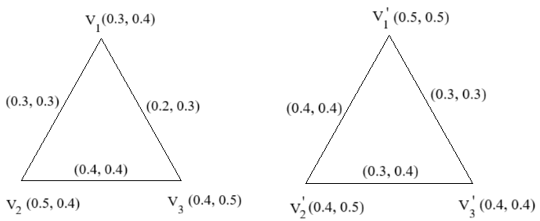
Example 3.3: Consider the following graphs G1 and G2
Figure 1. G1(V, E) and G2(V<i></i>, E<i></i>).
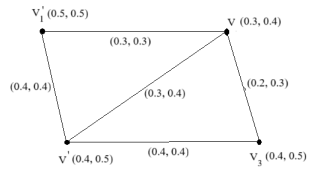
A parallel connection v1v2): (G2, v2v3)) is obtained by deleting the edges v1v2 G1 and v2v3 G2 and identifying v1 G1 and v3 G2 as v and v2 G1 and v2 G2 as v and introducing a new edge vv as per the definition. The resultant intuitionistic fuzzy graph is as follows.
Figure 2. P((G1, v1v2): (G2, v2<i></i>v3<i></i>)).
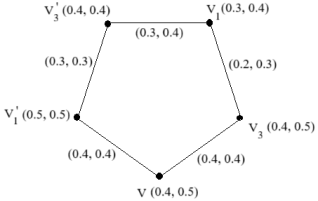
A series connection S((G1, v1v2): (G2, v2v3)) is obtained by deleting the edges v1v2 G1 and v2v3 G2 and identifying v2 G1 and v2 G2 as v and introducing a new edge v1v3 as per the definition. The resultant intuitionistic fuzzy graph is as follows.
Figure 3. S((G1, v1v2): (G2, v2<i></i>v3<i></i>)).
Theorem 3.4: Let G1(V, E) and G2(V, E) be two complete min-max intuitionistic fuzzy graphs then P(G1, G2) and S(G1, G2) need not be complete intuitionistic fuzzy graphs and not necessarily a min-max intuitionistic fuzzy graph.
Proof: The proof of the theorem follows from the below example.
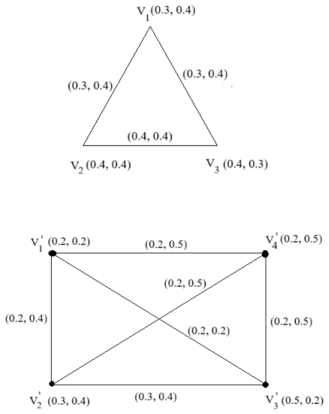
Example 3.5: Consider the following graphs G1 and G2
Figure 4. G1(V, E) and G2(V<i></i>, E<i></i>).
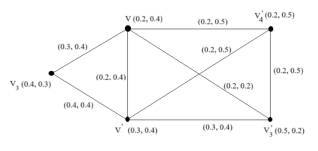
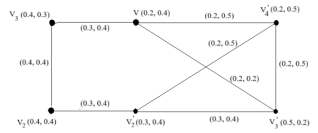
Consider the parallel connection P((G1, v1v2): (G2, v1v2)) by identifying v1 G1 and v1 G2 as v and v2 G1 and v2 G2 as v, the resultant intuitionistic fuzzy graph is given below.
P(G1, G2) and S(G1, G2) is neither a Minmax intuitionistic fuzzy graph nor complete which is obvious from membership functions of vv3 P(G1, G2), v3v P(G1, G2) and vv3 S(G1, G2). Thus the IFG’s P(G1, G2) and S(G1, G2) obtained above is named as Maxmax intuitionistic fuzzy graph and defined as follows.
Definition 3.6: A Maxmax intuitionistic fuzzy graph is of the form G: (V, E) where
(a). V = {v1, v2,..., vn} such that µA: V [0, 1] and A: V [0, 1] denotes the degree of membership and non-membership of the elements vi V respectively and 0 ≤ µA(vi) + A(vi) ≤ 1 for every viV; (i = 1, 2, …, n).
(b). E V×V where µB: V×V [0, 1] and B: V×V [0, 1] are such that µB(vi, vj) ≤ max {µA(vi), µA(vj)}, and B(vi, vj) ≤ max{ A(vi), A(vj)} where 0 ≤ µB(vi, vj) + B(vi, vj) ≤ 1 for every (vi, vj) E.`
Theorem 3.7: Two intuitionistic fuzzy graphs G1 and G2 with ‘m’ and ‘n’ number of edges respectively has 2mn parallel connections.
Proof: The number of ways of deleting one edge from each group containing ‘m’ and ‘n’ number of edges respectively is ‘mn’. By definition of parallel connection, combining two end vertices of deleted edges can be done in two ways. Hence the total number of possible parallel connections are 2mn.
Theorem 3.8: Two intuitionistic fuzzy graphs G1 and G2 with ‘m’ and ‘n’ number of edges respectively has 4mn series connections.
Proof: The number of ways of deleting one edge from each group containing ‘m’ and ‘n’ number of edges respectively is ‘mn’. By definition of series connection, identifying a pair of vertices from the end vertices of the deleted edges can be done in 4 different ways. Hence the total number of possible series connections are 4mn.
4. Conclusion
This study reveals that the Parallel and Series connections on two Minmax intuitionistic fuzzy graphs generates IFG which need not be necessarily Minmax IFG. The same study can be carried out on product IFG’s also. This article can be extended to electrical circuit diagrams by representing them using IFG and parallel, series connections of those circuit diagrams can be generated using the above definitions 3.1 and 3.2.
Abbreviations
IFG’s | Intuitionistic Fuzzy Graphs |
Author Contributions
Anandkumar Narayanasamy Venkatesan: Conceptualization, Resources
Nivethana Venkataswamy: Methodology, Writing – review & editing
Conflicts of Interest
The authors declare no conflicts of interest.
References
| [1] |
Atanassov, K. T., Intuitionistic fuzzy sets: theory and applications. Physica, New York, 1999.
https://doi.org/10.1007/978-3-7908-1870-3
|
| [2] |
Bhattacharya, P, Some Remarks on Fuzzy Graphs, Pattern Recognition Letter 6: 297-302, 1987.
https://doi.org/10.1016/0167-8655(87)90012-2
|
| [3] |
Karunambigai M G, Parvathi R and Kalaivani O. K, A Study on Atanassov’s intuitionistic fuzzy graphs, Proceedings of International Conference on Fuzzy Systems, FUZZ-IEEE, Taiwan, 157-167.
https://doi.org/10.1109/FUZZY.2011.6007416
|
| [4] |
Nagoorgani A and Malarvizhi. J, Isomorphism on Fuzzy Graphs: International Journal Of Computational and Mathematical Sciences, Vol. 2(4), 2008, 190-196.
https://doi.org/10.13140/2.1.1873.9847
|
| [5] |
Nagoorgani A and Malarvizhi. J, Isomorphism properties on strong fuzzy graphs, International journal of Algorithms, comp. and Math, Vol. 2(1), 2009, 39-47.
|
| [6] |
Nivethana V and Parvathi A(2015), On Complement of Intuitionistic Fuzzy Graphs, International Journal of Computational and Applied Mathematics, 10(1), 2015, 17-26.
|
| [7] |
Nivethana, V. and Parvathi, A. "Extended regular intuitionistic fuzzy graphs" IOSR Journal of mathematics Vol. 12, Issue 4(3), 2016, 06-12.
https://doi.org/10.9790/5728-1204030612
|
| [8] |
Nivethana, V. and Parvathi, A. " Operations on Intuitionistic Fuzzy Graphs”, International Journal of Advanced Scientific and Technical Research, Issue 7, Vol. 3 May-June2017.
|
| [9] |
Parvathi R and Karunambigai M G, Intuitionistic fuzzy graphs, Computational Intelligence, Theory and applications, international conference in Germany, Sep 18-20, 2006.
https://doi.org/10.1007/3-540-34783-6_15
|
| [10] |
Parvathi R, Karunambigai M G and Atanassov, K. T., Operations on Intuitionistic fuzzy graphs, FUZZ-IEEE 2009, Korea, August 20-24, 2009.
https://doi.org/10.1109/FUZZY.2009.5277067
|
| [11] |
Parvathi R, Karunambigai M G and Atanassov, K. T., Operations on Intuitionistic fuzzy graphs II, International Journal of Computer Applications Vol. 51(5), 2009, 1396-1401.
https://doi.org/10.5120/8041-1357
|
| [12] |
Rosenfeld, A. Fuzzy graph, in: Zadeh, L. A. Fu, K. S. and Shimura, M. (Eds.), Fuzzy sets and their applications to cognitive and decision process, Academic Press, New York, 1975, pp. 77-95.
https://doi.org/10.1016/C2013-0-11734-5
|
| [13] |
Sankar Sahoo and Madhumangal Pal, Different types of products on intuitionistic fuzzy graphs, Pacific Science Review A: Natural Science and Engineering, Vol. 17(3), November 2015, Pages 87-96.
https://doi.org/10.1016/j.psra.2015.12.007
|
| [14] |
Talal Al-Hawary, Certain Classes of fuzzy graphs, European journal of pure and applied mathematics, Vol. 10(3), 2017, 552-560.
|
| [15] |
Zadeh LA, Fuzzy sets, Information and control, Vol. 8(3), 338-353, 1965.
https://doi.org/10.1016/S0019-9958(65)90241-X
|
Cite This Article
-
APA Style
Venkatesan, A. N., Venkataswamy, N. (2026). Series and Parallel Connections in Intuitionistic Fuzzy Graphs. American Journal of Applied Mathematics, 14(2), 74-78. https://doi.org/10.11648/j.ajam.20261402.15
 Copy
|
Copy
|
 Download
ACS Style
Venkatesan, A. N.; Venkataswamy, N. Series and Parallel Connections in Intuitionistic Fuzzy Graphs. Am. J. Appl. Math. 2026, 14(2), 74-78. doi: 10.11648/j.ajam.20261402.15
Copy
|
Download
AMA Style
Venkatesan AN, Venkataswamy N. Series and Parallel Connections in Intuitionistic Fuzzy Graphs. Am J Appl Math. 2026;14(2):74-78. doi: 10.11648/j.ajam.20261402.15
Copy
|
Download
-
@article{10.11648/j.ajam.20261402.15,
  author = {Anandkumar Narayanasamy Venkatesan and Nivethana Venkataswamy},
  title = {Series and Parallel Connections in Intuitionistic Fuzzy Graphs},
  journal = {American Journal of Applied Mathematics},
  volume = {14},
  number = {2},
  pages = {74-78},
  doi = {10.11648/j.ajam.20261402.15},
  url = {https://doi.org/10.11648/j.ajam.20261402.15},
  eprint = {https://article.sciencepublishinggroup.com/pdf/10.11648.j.ajam.20261402.15},
  abstract = {In this paper, we introduce two new operations on Min-max Intuitionistic Fuzzy Graphs, namely Parallel and Series connections along with some of its basic properties. Parallel and Series connections between two Min-max Intuitionistic Fuzzy Graphs are constructed and illustrated with relevant examples. Parallel connections and Series connections are obtained by deleting any two edges and introducing a new edge. Definition of Max-max Intuitionistic Fuzzy Graph is also introduced. Construction of Parallel and Series connections between two Min-max Intuitionistic Fuzzy Graphs gives rise to Max-max IFG which is a new type of Intuitionistic Fuzzy Graph where both the membership and non-membership functions of some of the edges are less than or equal to maximum of membership and non-membership functions of their respective incident vertices. It is shown that the number of edges in a Parallel connection is twice the product of edges in the two Min-max Intuitionistic Fuzzy Graphs whereas in a Series connection it is four times the product of edges in the two Min-max Intuitionistic Fuzzy Graphs. The study reveals that any two electrical circuits with its enclosed components (resistors, capacitors etc.) can be represented as vertices of two Min-max Intuitionistic Fuzzy Graphs and their Parallel and Series connections can be generated.},
 year = {2026}
}
Copy
|
Download
-
TY  - JOUR
T1  - Series and Parallel Connections in Intuitionistic Fuzzy Graphs
AU  - Anandkumar Narayanasamy Venkatesan
AU  - Nivethana Venkataswamy
Y1  - 2026/04/10
PY  - 2026
N1  - https://doi.org/10.11648/j.ajam.20261402.15
DO  - 10.11648/j.ajam.20261402.15
T2  - American Journal of Applied Mathematics
JF  - American Journal of Applied Mathematics
JO  - American Journal of Applied Mathematics
SP  - 74
EP  - 78
PB  - Science Publishing Group
SN  - 2330-006X
UR  - https://doi.org/10.11648/j.ajam.20261402.15
AB  - In this paper, we introduce two new operations on Min-max Intuitionistic Fuzzy Graphs, namely Parallel and Series connections along with some of its basic properties. Parallel and Series connections between two Min-max Intuitionistic Fuzzy Graphs are constructed and illustrated with relevant examples. Parallel connections and Series connections are obtained by deleting any two edges and introducing a new edge. Definition of Max-max Intuitionistic Fuzzy Graph is also introduced. Construction of Parallel and Series connections between two Min-max Intuitionistic Fuzzy Graphs gives rise to Max-max IFG which is a new type of Intuitionistic Fuzzy Graph where both the membership and non-membership functions of some of the edges are less than or equal to maximum of membership and non-membership functions of their respective incident vertices. It is shown that the number of edges in a Parallel connection is twice the product of edges in the two Min-max Intuitionistic Fuzzy Graphs whereas in a Series connection it is four times the product of edges in the two Min-max Intuitionistic Fuzzy Graphs. The study reveals that any two electrical circuits with its enclosed components (resistors, capacitors etc.) can be represented as vertices of two Min-max Intuitionistic Fuzzy Graphs and their Parallel and Series connections can be generated.
VL  - 14
IS  - 2
ER  -
Copy
|
Download





 Share This Article
 Twitter
 Linked In
 Facebook