1. The Scientific and the Semiotic Status of the Object in Language/Linguistic Autism
The present argument deals with a non-pathological approach to language-based dimension of autism. In order to provide a very brief introduction to this approach, we need to grasp the distinction between mental cognitive operations bearing internally a continuous diagram of inferences with the object (in the mathematical-epistemic sense) as a horizon, which is what some methods can be when it comes to the relation between language/mind and medical, cognitive, psychological levels. In another brief tone, the ROAL model (Real Object Approach of Language) is not dealing with pathological nor it is addressing etiological dimensions of autism, pretending for instance that autism is ’linguistically curable/non-curable’.
| [1] | Bakrim, N., Spaces, Dimensions, Events: The Real Object Approach of Language- a Hypothesis on Language (along with a Text in French). Paris: BoD; 2024, 5-88. |
[1]
.
Moreover, the knowledge space is not the therapeutic space of observation. In its reduced definition, it stipulates that consciousness is a monistic dimension and its mental operations can be reduced to language, epistemic-mathematical models through the same considerations stating that the proper text/field is a bidirectional mental-physical principle mathematically modeled in which unbounded abduction, deduction and induction are enabled. Secondly, the very non-pathological principle of these considerations can be summed up in the following:
The diathesis on a parameterized plane in which the autistic inversion is a consequence of perception-production inversions.
Before coming to this aspect, let us first define the diathesis principle: autism is a framing/antiframing model on the knowledge of the space itself with the following duality
| [2] | Bakrim, N., The Autistic Space Conjecture: Text/Field and the Individuals of Consciousness’. In Bridging Biology and Behavior in Autism - Innovations in Research and Practice, Carotenuto, M. & Costanza, C., Eds., IntechOpen: London, UK, 2025, pp. 1-25. https://doi.org/10.5772/intechopen.1010189 |
[2]
.
Table 1. Framing duality.
Frame: Kg | Antiframe: Gk |
Text/field stable field configuration of surfaces (linear/non-linear/flat-curved) | Text/field varying configuration of surface/plane relations |
We deal herein with a polarized category in CEA individuals (Cognition, Emotion, Action) whose canonical formulas can be elaborated on from a class of demonstration formulas,
1) Participational event diathesis: actp1fact p1/ factp2act p2
2) Act event diathesis (action/emotion): AE / EA
3) Neurotype diathesis: Kg/Gk
The first frame - antiframe duality leads us to the principle of the knowing plane we will be briefly summing up.
1.1. Reminder on the Knowing Plane Duality and Its Components
One of the consequences of duality meaning an epistemic-mathematical between two language reasoning domains, frame and antiframe, is the methodological unfolding in three components which is hypothesized from a functional space of reasoning:
Kg/Gk parametrization is a subspace of functionals (implying vectors), a canonical class of duality and its applicability
Secondly, domain variation, generated by applicability of the function with its properties; enables to nicely describe the knowing plane, especially polar coordinates and properties of the duality. Henceforth, complex/real properties can be redefined in the following argument
. In order to epistemize the deductive side of these consideration, we add a parametrization space to act
fact formula (or epi
meta) of the three-dimensional field. Henceforth, a methodological model we reduce to the following:
On a manifold of consciousness Mact fact whose three-dimensional M3 is the brain-consciousness manifold physical-mental space of language (the low-dimensional manifold), let the complex-real valued functional (F(g)) space ensure the generation of linear/non-linear vector space along with random complex-real endowment, let Kg/Gk duality be defined by G (complex gradient) and K (linear trace) and be a subspace polarity P (GK) be the epistemic parametrization of the knowing space, then there is a conformal duality between Kg and Gk implying the following hypotheses:
1) random complex processes are borne by prime number/polarity in random walk search/zeta function and its resuming spiral (multiple zeros)
| [4] | Wikipedia. Riemann_zeta_ function. Available from:
www.wikipedia.org (Accessed: 15 October 2024) |
[4]
along with observed elements (truncation, echolalia....)
2) Boundary search (Brownian motion in its partial dynamic) is nicely related to a 3D random walk in duality of ℕ3 individual structure (tensegrity) and prime number gap generation
3) The Brownian motion of the epistemic particles implies differential relevance, in particular the relevance of ergodic dimensions of the process ∂I
1.2. Observation, Sequence, Participation: The Individual Tensegrity of the Field
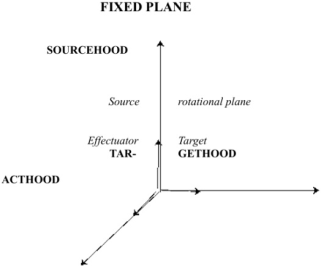
From the scientific ROAL (Real Object Approach of Language) approach, especially the principle sequences, has been defined from the invariants of consciousness which are individuals of the field from random discrete applicability of
source, target, effectuator axes (within bold representation of fixed plane). One of the major challenges of language-linguistic observation is undeniably the absence of space-mathematical and space-physical awareness in both theoretical and applied linguistics, in particular the point-, curve- and linewise existence of language arguments and the elements of its mathematization. Our core contribution herein is the distinction between the textual nature of language knowledge (mentally stored, mathematically recursive) and the linguistic argument or verb argument relying on the relation between fixed and rotational plane. In this specific case, the notion of epistemic particles enables a mapping of an empirical setting equipped with the aforementioned prudence of language/non-language boundaries in which we only concern ourselves with our own hypotheses. Furthermore, the physical modeling understands the conversation as the primary source of observation in which phonon/photon relevance is embedded in the language modeling of our knowledge: thus, the particulate nature of language makes it possible to model non-particulate (or material phenomena) content such as the non-wave senses (smelling, touching, tasting). Lotman’s concept
of primary and secondary modeling systems could offer an excellent rereading on the light of those considerations.
Moreover, mathematization implies also the status of numbers and their relevance on different axes of the text (syntax, morphology etc etc), a debate we will tackle in the second section.
Figure 1. Fixed and Rotational Plane.
From the following observation table model
Table 2. Semantic/syntax observation.
Observation Individuals | Symptomatic input | Observable output | directionality |
Action Cognition Emotion | Action linguistic exponents | Observed | Knowing field | Field/text relevant level | Exponent applicable | GK |
e.g truncation | Infeld/Umfeld (neurodiverse) | Verb valence ‘donner glace’ | Source → target (syn.) (SXT)V ar (Sem.) |
Action non-linguistic exponents | e.g motion towards the fridge | Umfeld / Infeld (neurotypical) | Motion | effectuator→ target (syn.) (PrXT)V ar (Sem.) | Kg |
Linguistic and non-linguistic sequences are embedded in a propositional principle in the sense of a symptomatic
observed relying on a methodological principle in the sense of internal (Infeld) and surrounding (Umfeld) interactions. We call this axis, the variant - invariant axis. Therefore, the hypothetic distinction between sequentiality and participational elements on duality: That is to say, the autistic/antiframing of doubled sequentiality within the individual structure is itself doubled by polar duality of above-mentioned diathetic elements from haplo/diplo-arguments on ploidy
| [6] | Ashe, A., Colot, V., Oldroyd, B. P.; How does epigenetics influence the course of evolution?. Philos Trans R Soc Lond B Biol Sci; 376 (1826), 2021, 1-9. https://doi.org/10.1098/rstb.2020.0111 |
[6]
. An important element of this element points out another hypothesis relying on individual structure, especially wholes of units W
U and dialogic points of natural number random applicability of ploidy.
P (k, X) = 2k+ x (k and x being independent variables with x representing additivity/deletion taking N+1/N-1 and returning random WU)
Henceforth, to test our hypothesis on co-observability and co-semioticity in autistic observation, we expose our methodological dealing and results.
2. Testing Co-Observability/Co-Objectivity
The second phase of the research
In the first phase of this research, we tackled the mathematical-epistemic hypothesis of the knowing plane. The knowledge space of autism within/independently from the knowledge space as a mathematically modeled, language-based space. Beyond the procedure, we will be exposing a focus on the duality from and within the principles of the knowledge space.
2.1. Procedure and Method
2.1.1. Observed and Observable
We first obtained a collection of questionnaire data with quantitative/qualitative balance (age, sex, spectrum condition, speaking/non-speaking status, comorbidity and risk factors) submitted to parents and legal representatives (components A, B, C) standing for data comparison (observation diagnosis data), personal data on linguistic/non-linguistic individuals of CEA. Secondly, we applied discrimination criteria on the observed from videos and photos of the participants with caregivers.
The discrimination procedure enabled the following elements. We will first define a CEA sequence from the observed perspective as both linguistic (given within an individual language) and non-linguistic (rendered by language propositional infeld/umfeld dualities) delimiting as such the space of conversation/interaction/situation and presentifying elements on internal and surrounding field whose structure is both representationally and coherently given within the space of field observation and guaranteed by hypothesis, model and preceding results on the subject.
Worth mentioning that the avoidance of the sole verbal perspective, especially in the perspective of autistic/non-autistic duality makes it possible to integrate verb argument principles (linguistic) into a language principle of sequences where larger consciousness propositions rely on the applicability of the knowing plane, in particular the diathetic split (or diathetic space partition) of Action Emotion and fact exponentiation of Cognition. A complex-real valued plane and its autistic inversion parametrizes the proper knowing points of text/field grounding in the linguistic knowledge as the core element of text representation or the epistemic-mathematical content underlying the language cognitive operations. Henceforth, to better deal with the non-therapeutic approach, the observable is an epistemic-mathematical principle endowed with algebraic, geometric and topological components.
Under the principle of observed - observable distinction, we apply a propositional principle of CEA individuals (Cognition, Emotion, Action) to sequences implying argument-predicate principle. In this sense, we operate a distinction mentioning the status of CEA individuals as invariant outputs (by Emotion we don’t mean only emotional semantic targethood from verb argument but any diathetic duality of targethood), whereby we don’t either mean ‘terminal ends’ of language recursions. Hence, both in the observed and the observable, CEA (Cognition, Emotion, Action) will play a second role in the making of the method. It is justified by both duality of autism and the duality frame generation on one hand and the accessible status of source - target - effectuator exponents of the CEA individuals (Cognition, Emotion, Action). We, secondly employ the double representation plane of sequences.
2.1.2. Tensegrity and the Individual Structure
Configuration has been one of the consequences of the text-field model in which gestalt considerations of field assembly of points and consciousness data have been regarded as an important element of the hypothesis. The foundational theory of Karl Bühler (the Organon-schema or the configuration of the representational, deictic and symbol fields), which is one of the leading empirical approaches on experimental linguistics (one of the fewest having sensed the necessity of such a field design) enables links between text relevance levels and its configuration points.
“It hardly needs to be emphasized that the influence of ‘’inner field’’ (Infeld) and the surrounding field (umfeld) is reciprocal. In the several holistic views that are nowadays summarily called Gestalt psychology, this in sight was expanded and transferred to many other things. It is one of those facts that have never been completely overseen or denied, but which are today much more carefully worked out previously, namely that the sense data usually do not occur in isolation, but are embedded or integrated into various mental processes as encompassing wholes in which they are corresponding subjects to various modifications. The term ‘’surrounding field’’ seemed appropriate and has gained currency’’
| [7] | Bühler, K., Theory of Language: The Representational Function of Language. Amsterdam: John Benjamins Publishing; 2011, 174-175. |
[7]
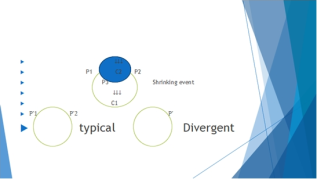
A coherent mathematical representation of the latter is given by the status of complex prime numbers and their angle/circle mapping, especially circle shrinking operations under which participational points come to form the One-Event Text (OET) within individuation from the OTO (One Text Object) bidirectional algorithm on Sourcehood, Targethood, Acthood coordinates. Secondly, Voronoi diagram of circle inclusion have oriented the following argument as means to represent the observed abstraction of data
. On the linguistic level of data, phenomena such as multiple truncation of acts and facts (rules) in which a descending model can be observed (from syntax to phonetics: subject/valence, agreement, syllable, etc etc)
From the small circle theorem
or the intersection of three circles in ℝ
2Given p≥ 3 circles in ℝ2 three of the circles are such that the smallest circle encompassing those three encompasses all of the circles’ (p. 190).
We first introduced the model of shrinking/fading away as presented below
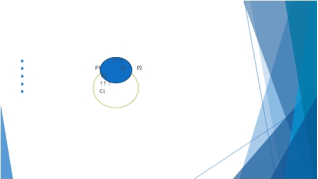
Figure 2. Shrinking/fading away.
-
1) Circle shrinking inclusion operations under which participational points come to form the One-Event text within individuation from OTO bidirectional algorithm on S, E, T coordinates. The shrinking of C1 to C2 will include P3 within the intersection following the theorem
2) The fading away of the bigger circle C1 from C2 resulting in various shrinking phases (spectral autism conditions) to intersection points
Secondly, a tensegrity model has been conceived. The link between geometry, physical observation and configuration grounding in tensegrity comes for free: tensegrity laws provide us with the orientation of modeling, the language modeling of non-language phenomena (motion, forces etc etc). Said in a different tone, frameworks are stable, inertia markers of structural nature enabling to reduce any morphodynamic phenomenon, under rotation or under a fixed frame, to an algebraic dealing.
We provide herein a theoretical presentation of tensegrity from Fuller’s synergetics. Secondly, a mathematical definition will be provided later on
«Tension and compression always and only coexist and covary inversely. We experience tension and compression continuously as they intercommodate the eternally intertransforming and eternally regenerative interplay of the gravitational and the radiational forces of universe›
| [10] | Fuller, R. B.; Synergetics 2, explorations in the geometry of thinking (Vol 2), San Francisco: The Estate of R. Buckminster Fuller, 1983, 165-166. |
[10]
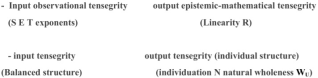
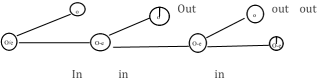
Figure 4. Tensgrity (input - output frames).
Equipped with the definition of the sequence on CEA individuals (Cognition, Emotion, Action), we rely on the distinction between (S, E, T) exponents being nodes and the tensiles, compressible, being the morphogenesis of the structure resulting in rigid bars and rigid or non-rigid tensegrity. We label tensiles and compressibles from inferential arrows of discrete random applicability on the rotating plane. In so doing, we distinguish random discrete arrows of exponents given within the event from mathematical rigidity/non-rigidity. To help us redefine rigidity and non-rigidity on the light of our duality,
«A tensegrity graph T = (V, B, C, S) is on vertex set V { v
1, v
2,.......v
n} and edge set E = B U C U S. The elements of E are called members and are labelled as bars, cable and struts, respectively. A tensegrity graph containing no bars is a cable-strut tensegrity graph. The underlying graph of T is the (unlabelled) graph T= (V, E). A d- dimensional tensegrity framework is a pair (T, p) where T (V, B, C, S) is a tensegrity graph and p is a map from V to R
d. (T, p) is also called a realization of T. if T has neither cables nor struts then we may simply call it a graph and a realization (T, p) is said to be a bar framework. An infinitesimal motion of a tensegrity framework is an assignment of infintesimal velocities μ
i ℝ
d to the vertices, such that (p
i - p
j) (u
i - u
j) = 0, for all ij
B (p
i - p
j) (u
i - u
j) ≤ 0 for all ij C, (p
i - p
j) (u
i - u
j) ≥ 0 for all ij
S ›
Considering that any tensegrity framework enables rotation which is one of the conditions of its rigidity, we deal thus with the following methodological generation of set class of propositional sequences from an empirical principle of the observed in which a tensegrity is a stress equilbrium obtained from dynamic elements mathematically epistemized and modeled. Henceforth, from our epistemization proposal on the bidirectional text, polynomiality is the mathematical property governing recursion with its graph/geometric and topological sides. However, our interest in polynomiality lies within the tensegrity notion of rigidity. Therefore, the model we present herein is a model of typed epistemized ℝ along with a framing-antiframing bidirectionality from text biderectionality. We first construct the typed universe of duality on the bidirectional text type in which texts are mere propositions. In this sense, from our considerations on the knowledge space, mere propositions imply the status of number space predicates especially the status of higher / lower components of brain-consciousness. In this case,
Table 3. Higher/lower consciousness orders.
Higher | Lower |
- Communicome | - Symbiome |
- Cognome | - Cognome |
- Connectome | - Connectome |
- Dynome | - Dynome |
- Genome/Transcription | - Genome/Transcriptome |
Furthermore, prime numbers (from the autistic antiframing) and number space predicates, regarding the epistemic-mathematical dealing, enable us to construct a common typing space of mere proposition
| [12] | Awodey, S., Coquand, T., Voevodsky, V., Homotopy Type Theory: Univalent Foundations of Mathematics. Princeton: Institute for Advanced Studies, 2013, 111-420. |
[12]
. Thus, restricting the predicate reducibility to only propositionality, we define this property in replacing belonging sign
with type equivalence in x
framing and y
antiframing are to be redefined
For all xframing/ yantiframing,we have xframing= yantiframing(Type equivalence)
In which case, from dependent type function there is a duality and bidirectional path between xframing and yantiframing, thus for any P: KS (KS the knowledge space universe) is Prop (p),
Is Prop (P): ≡∏x framing, yantiframing: p(xframing= yantiframing)
By continuity, we construct another property Q and pointwise propositionality on KS in which for all aframing, bantiframing: Aframing and pframing, qantiframing,
we can write f (aframing, bantiframing, pframing, qantiframing): p = q and g (a,b,p,q) ÷ p = q
Secondly, from the latter we can shift to define polynomial vector space of Ks. On the real part ℝ
d(ks)of the K
g/G
k duality, propositional polynomials have the following characteristic. Defining the space of K-rationals
| [13] | Bakrim, N.; The Manifold Object of Language: A Bio-Mathematical and Socio-Mathematical Hypothesis from the ROAL-Model (3). Paris: BoD; 2022, 5- 68. |
[13]
, we mention especially the role of the translation surface and its rotation index)
Let birationality (on sterographic projection, ergodic event levels) be a mode of propositional observability, especially in autistic duality (hypothesizing rationality as one of the properties of duality) defining secondly a k-rational point or the set of common zeros in K
n collection of polynomials in k (Wikipdia, 2025)
| [14] | Wikipedia. Rational points. Available from:
www.wikipedia.org (Accessed 20 October, 2025) |
[14]
F1(x1,..........., xn) = 0
Fr(x1,..........., xn) = 0
Then, in terms of our framing/antiframing duality, considering a two-sided Dedekind space where, L, U ⊆ ℚ are the lower/upper cuts
Figure 5. Lower/upper cuts.
If rational cuts are located in Ui a result in predicative Dedekind Reals (Ui+1, Ui +2;............) allows for Ω propositional: isCut (L, U), ℝd: ≡ { L, U): (Q → Ω) │isCut (L, U)}
We will in the remainder only concern ourselves with the language symbolic operation of duality in the sense that structural individuation is monistically seen from connectomic viewpoint.
Given odd/even natural numbers property (sequence property) where ℕ2K:2K ⇆ ℕ (p) odd/even duality of autism,
Given PM vector projective map mapping 1ℕ ⇆ ℝo/e
Given forgetful functors on sequence duality odd/even ⇆ odd in which left adjointure
From mere propositional property, we rely on the classes of understandable/non-understandable sequences or full interpretation (syntax/semantics) sequences, in which perfect elimination ordering and choosability defined on the S B C graph chordal and non-chordal cycles.
From choosability theorem
| [15] | Erdös, P.; Rubin, A. L.; Taylor, H.; Choosability in graphs. Congr. Numer., 26, 1980, 125-157.
http://users.renyi,hu/~p_erdos/1980-07.pdf |
| [16] | Allagan, J.; Su, J.; Gao, W.; Gao, S. Choice Numbers of Chordal, Chordless, and Some Non-Chordal Graphs. Mathematics, 13 (8), 2025, 1337.
https://doi.org/10.3390/math13081337 |
[15, 16]
especially on bipartite graphs on the duality, «the complete k-partite graph k (2, 2,...) is chromatic choosable». furthermore, relying on our semantic/syntax theorem chordal graphs, duality and representability whose form is the following
| [17] | Bakrim, N., Text, Duality and the bidirectional Semantic Knowledge: A mathematical-epistemic model for Semantics (submitted) 2024. |
[17]
.
« For a chordal graph with simplicial and two non-adjacent distinguished by a separator on compositional cycles, a Perfect elimination ordering induces an evaporation function from compositional to conceptual and dually reversed by concept neighbourhood »
We specify herein odd/even choosability, especially on chordal/chordless graphs, defining thus the choice number as the constant function f(j) = k where ’the choice number of G is equal to k if G is k-choosable but not (k-1) choosable. Hence from our propositional classes, we redefine duality of even/odd framing/antiframing designating by k = even choice (framing) and k-1 =odd choice number (antiframing) (kk-1). Secondly, relying on chordless and chordal compositional/semantic and non-chordal conceptual propositions, especially from connectomic/cognomic perpsective, we prove herein subsets of induced graphs or Perfect elimination ordering (full interpretation) and non-perfect elimination ordering (incomplete interpretation)with p. complete and non-p. complete propositions.
Given parallel/antiparallel valence duality of higher order consciousness and relying on polynomial mapss/functors
Given the set of odd concept interpreting neighberhood with antiframe in valence (antiparallel) being (k-1) complement of G’ (V’, E’) in G (V, E’) and a subset Ep.c ⊆ E and the subsets of E’npc⊆ E’, a duality graph of full /non-full interpretation (compositional/conceptual) implies a perfect and non-perfect elimination ordering in In/out polynomially/non-polynomially complete edge maps (o for odd and e for even)
2.2. A Framework of Tensegrity: An Algebraic Inquiry of Rigidity
The following method on tensegrity of the knowledge space relates to an algebraic frame in which cables, bars and struts (B U C U S) are combinatorially defined. In a very precise term, the framework on ℝn/ℝnd is the odd/even linerarity of full/non-full interpretation. The following proof on propositional data will be focusing on the projective aspect of the duality, ℝd/ℝd+1 hypothesis or rigidity/non-rigidity.
Given the embedding of the finite even/odd point configuration of G
{p
1, p
2......p
n} and the subset odd points {p
1, p
2......p
n+1} in ℝ
n .
Given the general position point (no d+1 point lies on the same hyperplane), Given the individual parametrization of common zero polynomials on individual geometrical family of the tensegrity (configuration of the field)
Given W stress (a scalar and its coefficients) or equilibrium, we construct the exterior product under the following form: this argument from Grassmann Algebra
| [19] | Grassmann, H., Die Ausdehnungslehre: Vollständig und in strenger Form bearbeitet.Cambridge: Cambridge University Press, 2013, 1-385. |
[19]
enables us to shift from the notion of stress into its algebraic modeling.
Being V the vector space of the edge space E (S U B U C), in this sense of the exterior algebra or grassmann Algebra is the free-graded algebra, given the rank of the exterior product enabling to span and decompose K-vectors, where α ∈ ∧ (V)
k and its linear decomposition
| [20] | Wikipedia. Exterior algebra. Available from:
www.wikipedia.org (Accessed 20 October, 2025) |
[20]
.
α = α(1)+ α(2)+ α(3)+......αkand α(2)= α1(2)∧α2(2)
Therefore, the basis ei of V directs us toward a the scalar coefficients of α and,
Secondly, taking the symmetric/antisymmetric consideration to be the case of aij, where aij = -aji with matrix rank even and twice α-rank if only if
α∧α.....α ≠0 (rank p)and α∧α.....α= 0 (rank p+1)
Which leads us to the alternating property of the alternating product on V (the vector space of framework edges) in which
Permutating its integers [1,....k], for x1,....xk or the elements of V (the vector space of the framework edges) with the following property
Xσ(1),∧.xσ(2)..∧xσ(k)where for ij,x1,∧.x2.....∧xσk= 0
Given the mapping of k-vectors ∧k (V) ⟶ X from the alternating operator f: Vk ⟶ X, stress and self-stress alternate.
W self-stress is the sum
(Edge)
The odd points being on (d+1),
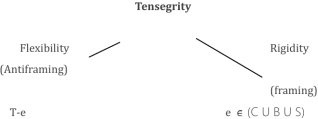
In the sense of ∀i, ∑ij wij (pi - pj) ≤ 0 on odd neighbourhood cable edges C (or T - e)
Therefore, the following scheme
Figure 7. Flexibility/rigidity.
3. From Co-Observability / Co-Objectivity to Co-Semioticity in Autism
We, thus, define co-observability/co-objectivity in autism duality on the monistic knowledge space in which observation and objectification points are a symbolic language embedded in connectome/cognome with equilibrium/non-equilibrium states and input in the epistemic particles of the text.
3.1. Epistemic Numbers and Distribution: The Semiome
In this section, we present a semiotic/co-semiotic model for autism, co-semioticity being the duality map of interpretability and explanability from cyclic conditions of sequences and ACE inputs and their monistic principles.
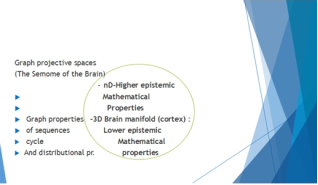
Furthermore, we hypothesized the semiome as the graph property space of the brain-consciousness in the following sense:
Figure 8. The semiome and brain-consciousness orders.
Independently from projection space whereby our semiotic model defines the duality of science (objectivity) and its Bedeutung (the Fregean first order predicates of reference), the connectome/cognome graph space is understood as the semiome or the semiotic space of the brain.
In this sense, graph spaces, especially their status within the mathematical spaces imply inferential principles that are not only meta-mathematical, they rather suggest a theoretical basis for interpretability/explanability and their relation to analytical models of language in the sense of both epistemic and semiotic-epistemic models. In this sense, it is the theoretical condition given by projection planes and projection graphs providing thus our symbolic language operations for the following argument.
Secondly, we also hypothesize epistemic number space E enabling to define Xactfact monistic space.
For n epistemic-neural, Language state integers (epi/Act) and X complex epistemic facts (meta-), and S, a scalar
n ! = S. f (x,n), where X {x1,.........xm} and S {s1,......sk} or the set of coefficients (exterior product reasoning), n {n1,...........nn’}
And f (x,n) = ∑x m, n’ (nx-nx-1)
In this sense, we address epistemic variables, cycle addition/deletion where
E = ℤ U ℂ U ℝ or the disjoint union of rules and f (x, n) ∈ ℤ∩ℂ∩ ℝ
3.2. Dimension Sharing and Co-semiotics
Let the M
actfact be the lower brain-consciousness manifold, defined by boundary union and cobordism,
| [21] | Wikipedia. Cobordism. Available from www.wikipedia.org (Accessed 20 October, 2022) |
| [22] | Galewski, D. E., Stern, R. J., Classification of Simplicial Triangulations of Topological Manifolds, Annals of Mathematics, 111(1), 1980, 1-34. https://doi.org/10.2307/1971215 |
[21, 22]
∂ (X.Y) = (∂x.y) U (x.∂y)
Let its dimension be n = p + q with Q = ⅅp.Sq ⊂ Mactfact or the cutting or surgery at the intersection of Sp.ⅅq and gluing = Sp+1. ⅅq-1 along the boundary,
∂ (Sp.ⅅq) = Sp.Sq-1 = ∂ (ⅅp+1.Sq-1) endowed with an elementary cobordism (W, M, N), M is obtained from N by surgey ⅅp+1.Sq-1 ⊂ N
Now let the disk Dq and the sphere be respectively the antiframing/framing poles, its dimensions is then n = p+1
Referring to n as the low-dimension brain manifold, then in this sense
We then stipulate a model of co-semioticity, in which case, a duality split of object and its semiotics built upon the framing valence.
3.3. Duality and Distribution
From the semiotic model of the ROAL (Real Object Approach of Language), implying the semiosis duality between interpretability/explanability and sequence on one hand and the semiotic algorithm of translata on the other hand from the type coordinate operations or projection n-1 spaces, distribution of sequences will be dealt with herein.
Let the duality graph be prime-non prime (odd/even) embedded on projection plane, let the graph
be defined by bipartite prime/non-prime decomposition, especially taking into consideration that the epistemic number (or the act/fact distribution cycles of addition/deletion) enable a lower order projection of points/lines (complex-real),
From modularity of epistemic numbers (prime/non-prime) being induced by their Gaussian integer property of remainder/modulo structure of congruence
| [24] | Klee, S.; Lehmann, H.; Park, A.; Prime labeling of families of trees with Gaussian integers, AKCE In ternational Journal of Graphs and Combinatorics, 13(2), 2016, 165-17.
https://doi.org/10.1016/j.akcej.2016.04.001 |
[24]
and residue classes, we scrutiny in the following the distribution property of semiotic duality on its sequences.
3.3.1. The Distribution Property of Semiotic Duality: A Testing Method
In this section, we introduce the following argument: distribution testing on dualities of modular distribution, interpretability/explanability. Grounding in Schwartz theory of distribution
| [25] | Alvarez, J.; A Mathematical Presentation of Laurent Schwartz’s Distributions, Surveys in Mathematics and its Applications, 15, 2020, 1-137. www.utgjiu.ro/math/sma |
[25]
and distribution spaces, we will be scrutinizing two distributional properties (or meta-analytical properties).
Given modular distribution on the framing polarity, especially duality of distribution and cylicity from prime graph decomposition postulated (prime / non-prime), we first check the distributional property of convergence
Convergence and partial derivatives
Let K be a linear trace space of framing and K ∈ ℝn and G be the complex gradient space (G∈ℂ), φ is the test function for distribution in Dφ: ℝn ⟶ ℂ from a support of φ supp (φ)
In which case k ≠ G when φ is 0 on an open neighberhood of k,
Secondly, we use and adapt the following definition.
«A map T: D →ℂ is called a distribution if it is linear and (T,ϕj) → (T,ϕ) in ℂ as j → ∞, whenever ϕj → ϕ in D as j →∞. Let us repeat that a sequence {ϕj}j≥1 converges to ϕ in D as j → ∞ exactly when there is a compact set K ⊆ Rn so that ϕj,ϕ Dk for all j ≥ 1 and {ϕj}j≥1 converges to ϕ in Dk as j → ∞.»
Using our epistemic sequence (from the classical sense of distribution) ∑xm, n’ (nx-nx-1), let x be an even/non-prime or x ≥ 2 and x-1 a prime, considering the alternative series test and
- ∑x m, n’ nx, and ∑m, n’x-1 nx-1 are both monotonic
And
Lim nx = 0
M,n’ ⟶ ∞
Lim nx-1 = 0
M,n’ ⟶ ∞
Then ∑x m, n’ nx, and ∑m, n’x-1 nx-1 are convergent to 0, therefore ∑x m, n’ (nx-nx-1) is a distribution.
Secondly, from partial derivative object of distribution theory and the epistemic boundary search of autism
the duality tells us that G
K /K
G is an exponent inversion characteristic of the autistic knowledge in which sense, the complexity gradient is thus a derivational object.
Furthermore, once again, from T taking functionals since φ (test function) belongs to D
∂xk (∂xjφ) = ∂xj (∂xkφ) for 1 ≤j, k ≤n
Hence, for the derivation order and given ℕn /ℕn-1 on odd / even duality for any α ∈ℕn odd then (α-1 ∈ℕ n-1) when ((∂α T, φ) = (-1)│α│(T, φ) and given D ⟶ ℂ
φ⟶ - (T, ∂xjφ) for ℝn-1 therefore ((∂α-1 T, φ) = (-1)│α-1│(T, φ)
So the duality of distribution by derivation in which also derivation solvability is proven.
3.3.2. First Principles Governing Semiosis Duality (Sequence - Explanability/Interpretability)
The object of any scientific semiotic (to differentiate it from semiosphere/ideological semiotics) is a distribution D∈ℝ in the sense of Dφ: ℝn ⟶ ℂ whose classical form is given by modular and random (event) distribution models of the semiome (brain-consciousness).
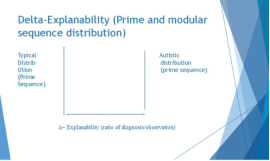
Figure 9. Delta-explanability.
A class of distribution of the sense n
x - n
x-1 where X is a complex Gaussian integer (facts) and n an act state can be related to its epistemic solvability (from G
k /K
G) and semiotic relevance of Planck Distribution Equation
| [27] | Ji, S.; Planckian Information (Ip): A New Measure of Order in Atoms, Enzymes, Cells, Brains, Human Societies, and the Cosmos, Unified Field Mechanics. November 2015, 579-589.
https://doi.org/10.1142/9789814719063_0062 |
[27]
y = A/(x + B)
5/(e
C/(x+B)Â −Â 1)
with free parameters A, B, C.
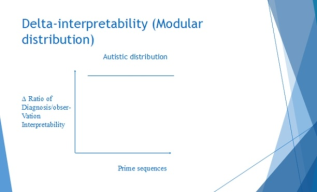
Figure 10. Delta-interpretability.
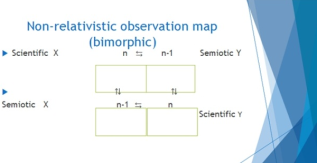
Therefore, the non-relativistic observation map with a bimorphic identity.
Figure 11. Bi-morphic scientific/semiotic maps.
The translata are coordinates of (n-1) level, making possible to write the algorithm of semiotic explanability/interpretability under the form of recursive projective points following the principle that no semiotic meaning can be written without a described object on n-level.
Secondly, regarding relevance levels, propositional principles that have their nature within genre/field intersection for (language within individual languages) suggest a rereading on the light of our 2024 model where the core idea is the criticism of narrative metaphorism, especially the non-linguistic expansion resulting in an allegorical projection of objective extra-linguistic and extra-language objects in the sense of epistemic knowledge intersecting with language potential double structuring
| [29] | Bakrim, N., The Real-Object-Approach of Language (ROAL-Model): A Bio-mathematical Attempt on Language and Consciousness, Paris: BoD, 2021, 5-64. |
[29]
.
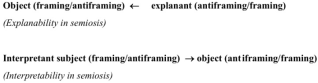
Figure 12. Direction of semiosis.
One of the elements of this debates is subject/object points along with the rereading of the realistic/non-narrative actant and non-narrative modality among other theoretical subjects. The model suggests that this duality is not a complex case belonging to ”mainstream semiotics”, it is the map tool that makes semiosis and semiotics operate profiting from exterior algebra’s frame of reasoning
The following table provides an insight into the differences between theoretical assumptions of scientific and semiosphere semiotics.
Table 4. The French post-Greimassian, phenomenological model of semiotics (Discourse Semiotics).
relevance levels | Ascending /Descending levels |
1) signs 2) Utterance-text 3) Situations 4) Praxis 5) Strategies 6) Forms of life | 1) intensive principles: rhetoric syncope 2) Extensive principles: Level integration 3) Tensivity (intensity/extent): tensive structure of the field and discourse values/ direct/inverse correlation |
Table 5. ROAL (Real Object Approach of Language) model component on semiotics and co-semioticity (2025).
The ROAL Model for linguistic semiotics (text/field) and object - semiotic levels | co-observation/co-semioticity (Duality in autism and non-autism) |
1) text/field semiosis/duality (propositional distributional principles): explanability/interpretability 2) Projective principles (language scientific object (n) / semiotics (n-1) | 1) Internal co-observation/co-semioticity: Bi-morphic map (scientific X ⇄ semiotic X) / scientific Y ⇄ semiotic Y) 2) External co-observationco-semioticity: Scientific X ⇄ semiotic Y Scientific Y ⇄ semiotic X |
4. Conclusion
One of the consequences of the knowledge space conjecture, is the mapping of the inverted mental space of autism in which the framing/antiframing duality is shaping the spectral/non-therapeutic dimension of language-linguistic through the space of observation/objectification and its semiotic elements of semiosis and projective translata. Hence, we notice the emergence of the same duality as a principle of co-observation and co-objectivity.
Therefore, what are the epistemic-mathematical elements of this duality being form-symbol elements of a language and regarding cognome, connectome and semiome components of the Brain-consciousness ?
From epistemic particles and points, procedural elements of observation and co-observation refer to the very notion of this duality being only one level of the knowledge space in our monistic understanding (scientific monism, to be underlined) yet from within the language-linguistic observed in the sense of both text knowledge formula (epimeta) and its duality parametrization (kg/gk): text/field are their own observables or language symbolic recursion. Regarding autism, especially from parametrizing accounts on inversion and the knowing plane, both epistemic-mathematical spectrum and higher-lower properties of the Brain-consciousness point out a common, bidirectional space of observation-objectification implying propositional types to which duality is reduced. Another level on the above-mentioned would be the rational space of this duality, especially rational cuts and their polarity.
Inversely, a stark distinction should be emphasized between symptomatic elements of verbal/non-verbal conditions on the spectrum and the following results from the ROAL-model (Real Object Approach of Language) in consistence with the same state of the art argument on the latter
| [30] | Trayvick, J., Barkley, SB., McGowan, A., Srivastava, A., Peters, AW., Cecchi, GA., Foss-Feig, JH., Corcoran, CM., Speech and language patterns in autism: Towards natural language processing as a research and clinical tool. Psychiatry Res, 340, 2024, 116109. https://doi.org/10.1016/j.psychres.2024.116109 |
| [31] | Bottema-Beutel, K., Zisk, A. H., Zimmerman, J., & Yu, B., Conceptualizing and describing autistic language: Moving on from ‘verbal’, ‘minimally verbal’ and ‘nonverbal’. Autism, 29(6), 2025, 1367-1373. https://doi.org/10.1177/13623613251332573 |
| [32] | Kissine, M., Saint-Denis, A., Mottron, L., Language acquisition can be truly atypical in autism: Beyond joint attention, Neurosci Biobehav Rev, 153, 2023, 105384.
https://doi.org/10.1016/j.neubiorev.2023.105384 |
| [33] | Walenski, M., Tager-Flusberg, H., Michael, T. U., Language in Autism, In Understanding Autism: From Basic Neuroscience to Treatment, Moldin, S. O., and. Rubenstein, J. L. R., eds., CRC Press: Boca Raton, FL, 2006, pp 175-204.
https://doi.org/10.1201/9781420004205.ch9 |
[30-33]
. Therefore, the mere-proposition reducibility on one hand and text-field empiricism (procedural to modelable axis including connectomic-cognomic directions) on the other indicate the validity of the One-Text-Object in redefining the proper knowledge space of language independently from lexical input/output considerations relating to collective individuality or cardinolinguistic individuality (or anthropological) assigning dialogic participation rules and points: we do strongly believe that, beyond psycholinguistic accounts, any empirical orientation should operate this distinction at the outset of any interdisciplinary observation bridging gaps between therapeutic/medical and linguistic science on autism.
Henceforth, this necessary prudence is our neuroscientific contribution to define the monistic foundations of form-symbol models able to distinguish between language and symptomatic-etiological aspects, especially from/into the connectome-cognome graph space if we may express it in a monistic mood. Thus, if we question number-graph theoretic interface, say from a non-linguistic concern such as genetic-neural insufficiency, autism proves being nicely a genuine argument in the valence/antivalence of higher-order graph properties (herein, semantic/syntax interface beyond lexicocentrism) in which observation and objectification are revealing their split polarity form both projective and odd/even recursion, representability of the bidirectional text. Recursion and its symbolic operations from the duality system previously discussed, strengthened by the latter, are by no means a generative interplay between internal and external text speculations in the kind of accounts from modern linguistics or the process of idealizing speculation instead of generalizing objective inferences. The proper modeling argument of these considerations is given by tensegrity whereby the notions of structure, both hierarchical-derivational and individual, encounter here the echo of applied and experimental requirements. Hence, regarding ACE individuals and the preserving of our rotational qualia under tensegrity frameworks, the epistemic-mathematical orientation; in its inverse move from physics to language, enables to deal with the invariant aspect of linguistic inertia in which diathetic duality elements represent rigidity/non-rigidity models along the empirical process; particularly perceptual spheres in their autistic inversion (for instance,
vicarious perception | [34] | Keysers, C., Gazzola, V.; Hebbian learning and predictive mirror neurons for actions, sensations and emotions. Philosophical Transactions of the Royal Society B., 369(1644): 20130175. https://doi.org/10.1098/rstb.2013.0175 |
[34]
and the neural language of sensor, control, effector instances make it possible to model dynomic-connectomic interactions within this duality. Worth mentioning are the firing/non-firing neural networks through the control system between inhibitory and excitatory systems and their rythmic correlates
Without a proper control system, principal-cell types connected by random, small-world, or any kind of network design would simply behave like autonomous avalanches, building up very large excitation over an ever-expanding territory and then shutting off from exhaustion. In order to generate the harmony of tensegrity in cortical circuits, excitation must be balanced with an equally effective inhibition.
| [35] | Buzsaki, G.; Rhythms of the Brain, Oxford: Oxford University Press, 2006, 59-60. |
[35]
Henceforth, from the observed (conversation points/topos within umfeld/infeld) to the observable, co-observability/co-objectivity are varying notions on rigidity and framework inertia.
It is the very making of these considerations that we target when dealing with empirical and experimental verifiability. In this particular sense, the task sharing comes for free when it comes to autism if we do really fathom the purpose of empirically experimenting «the autistic scene ». Therefore, physical and neurological setting might either seem incoherent with the language symbolic approach to autism or being attributed to psycholinguistic accounts on the subject. In reality, epistemic particles, their knowing/knowable considerations, could be consistently grasped through a process of epistemic quantization from text/field experience either fMRI/MEG (sensors) or experimental implants easy to build in/extract for linguistic experience purposes. Another desiderata of co-observability/co-objectivity could be the entanglement symbolic operations of both, especially through a monistic self-assembly model (word order and other aspects).
This leads us to modular distribution duality of mental-cognomic states mapping biological to symbolic operations of consciousness. Experimental event and random distribution of data refer to the very duality of modular decomposition (n/n-1) relevance in that sequences (from the above-mentioned dealing) entail a split in explanability/interpretability in which we experience scientific-objective maps (autistic / non-autistic) borrowing the same considerations: the text being the mathematical space of epistemization and its projective translata space. Co-semioticity can then be thought of as the proper space of modular understanding and/or interpreting of the inwardly oriented world of the autistic condition.






 Share This Article
 Twitter
 Linked In
 Facebook
 Copy
Copy Download