Abstract
Graph labeling is an important and rapidly developing area in graph theory due to its numerous applications in communication networks, frequency assignment, channel allocation, and coding theory. Among the various labeling methods, radial radio labeling has gained attention because of its connection with distance-based constraints and graph structure. In this paper, we study the radial radio labeling of certain connected subgraphs derived from complete graphs. We introduce the concepts of radial radio number and radial radio sequence and examine their behavior for specific graph classes obtained from complete graphs through edge deletions. The main objective of this work is to determine the radial radio sequence of connected graphs formed by deleting a perfect matching and an edge covering from the complete graph. Using fundamental graph-theoretic techniques and structural analysis, we derive exact values for the radial radio sequence of these graph families. The obtained results provide insight into the influence of graph structure and neighborhood properties on radial radio labeling. This study extends existing research on distance-based graph labeling and contributes to a better understanding of how structural modifications in graphs affect labeling parameters, which may further support applications in communication network optimization and interference reduction problems.
|
Published in
|
American Journal of Applied Mathematics (Volume 14, Issue 3)
|
|
DOI
|
10.11648/j.ajam.20261403.17
|
|
Page(s)
|
168-173 |
|
Creative Commons
|

This is an Open Access article, distributed under the terms of the Creative Commons Attribution 4.0 International License (http://creativecommons.org/licenses/by/4.0/), which permits unrestricted use, distribution and reproduction in any medium or format, provided the original work is properly cited.
|
|
Copyright
|
Copyright © The Author(s), 2026. Published by Science Publishing Group
|
Keywords
Radio Number, Radial Radio Number, Radius, Diameter, Radial Radio Sequence
1. Introduction
Throughout this paper, we only consider the simple, connected and undirected graphs. The closed neighbourhood of a vertex v is a subset of vertices denoted by and is defined by . The induced subgraph induced by the closed neighbourhood of is denoted as and is defined by , where . A clique, , is a subset of with maximum number of vertices such that is complete. The clique number, or , is the number of vertices in the clique of G.
A perfect matching in a graph G is a set M, of edges such that every vertex in G is incident to exactly one edge in M. Equivalently, M is a matching of size . Note that, a perfect matching exists only when the graph G has even number of vertices.
An edge cover or edge covering of a graph G is a set C of edges such that every vertex in G is incident to at least one edge in C. In other words, the union of end points of the edges in C covers the entire vertex set V(G). An edge cover is said to be minimum edge cover if it has the smallest of possible cardinality among all edge covers of G.
The distance between any two distinct vertices and is the length of the shortest path in G and is denoted by . The eccentricity of a vertex , , is the distance between and the vertex farthest from . The minimum eccentricity among all vertices is called as the radius of G and is denoted by rad(G). The maximum eccentricity among the vertices is called as the diameter of G and is denoted by diam(G).
The study of graph labeling has emerged as a significant area within graph theory, offering insights into combinatorial properties and their applications in network design, communication systems, and optimization problems. The concept labeling was introduced by Rosa, et. Al.
| [12] | A. Rosa, On certain valuations of the vertices of a graph, Theory of Graphs (Internat. Symposium, Rome, July 1966), Gordon and Breach, N. Y. and Dunod Paris, pp. 349-355, 1967. |
[12]
. The detailed study of Frequency Assignment Problem
by Chartrand et. Al.
| [6] | G. Chartrand, D. Erwin, F. Harary and P. Zhang, Radio labeling of graphs, Bulletin of the Institute of Combinatorics and its Applications, vol. 33, pp. 77-85, 2001. |
[6]
leads to the new concept of radio
k coloring.
A function is said to be a radial radio labeling, if it satisfies the following condition: for any two distinct vertices and ,
where
is the shortest distance between
and
. The inequality (
1) is known as the
radial radio condition of
. The
span of a radial radio labeling,
, is the largest integer in the range of
, and is denoted by
. The minimum span taken over all possible radial radio labelings of
is known as the
radial radio number of
.
Motivated by the concept,
sequence introduce by Selvam et. Al.,
| [3] | Selvam Avadayappan, M. Bhuvaneshwari, S. Vimalajenifer, Radial Radio Sequence of a Graph, International Journal of Mathematical Combinatorics, Special Issue, pp. 1–8, 2018. |
[3]
, the concept radial radio sequence is defined in the following manner: The non-decreasing sequence,
, is called as the
radial radio sequence of a graph G, where
is the radial radio number of the induced subgraph induced by the closed neighbourhood of the vertex
. Radial radio sequences of product of some standard graphs have been determined in
| [4] | Selvam Avadayappan, M. Bhuvaneshwari and S. Vimalajenifer, rr-sequence product graphs, Advances in Mathematics: Scientific Journal, no. 3, pp. 927-936, 2020.
https://doi.org/10.37418/amsj.9.3.18 |
[4]
.
The following lemma provides the necessary and sufficient condition for a function to be a radial radio labeling of a graph with radius 1.
Lemma
Let be a connected graph with . A function is a radial radio labelling of G if and only if |ς(u) + ς(v)| ≥ 1 whenever is an edge.
Proof
If , then the radial radio condition becomes
This completes the proof.
Remark
To verify the radial radio condition for a graph with radius 1, by above lemma, it is enough to show that the label difference between adjacent vertices is at least 1 and the label difference between non-adjacent vertices is at least 0.
Equivalently, the non-adjacent vertices may receive the same positive integers as labels.
The following theorem is useful in establishing the results of this paper.
Theorem A: For any simple connected graph G,
, where
is the clique number of G.
| [2] | Selvam Avadayappan, M. Bhuvaneshwari, S. Vimalajenifer, A Note on Radial Radio Number of a Graph, International Journal of Applied and Advanced Scientific Research, pp. 62–68, 2017. |
[2]
.
For further basic concepts, one may refer
and
| [8] | M. K. A. Kaabar, et al., Radio and Radial Radio Numbers of Certain Sunflower Extended Graphs, Journal of Mathematics, vol. 2022, Article ID 9229409, 2022.
https://doi.org/10.1155/2022/9229409 |
[8]
. For more results on radio number and the radial radio number, one can refer
| [1] | Selvam Avadayappan, M. Bhuvaneshwari, S. Vimalajenifer, The Radial Radio Number and the Clique Number of a Graph, International Journal of Engineering and Advanced Technology (IJEAT), Volume 9, Issue 1S4, pp. 1002-1006, December 2019. |
| [9] | B. Mari, Further results on the radio number for some construction of the path, complete, and complete bipartite graphs, Heliyon, vol. 10, no. 15, e35678, 2024.
https://doi.org/10.1016/j.heliyon.2024.e35678 |
| [10] | K. M. Paramasivam, K. Yenoke, B. S. K. Muralidharan, Radial radio number of chess board graph and king’s graph, TELKOMNIKA Telecommunication Computing Electronics and Control, vol. 20, no. 1, pp. 189–196, 2022.
https://doi.org/10.12928/TELKOMNIKA.v20i1.19493 |
| [11] | R. Ponraj, S. Sathish Narayanan, Radio Mean Number of Certain Graphs, International Journal of Mathematical Combinatorics, vol. 4, pp. 45–53, 2021. |
[1, 9-11]
and
| [13] | S. Vimalajenifer, Radial Radio Sequence of Path-Deleted, Cycle-Deleted and Star-deleted subgraphs of the complete Graph. (Submitted). |
| [15] | K. Yenoke, et al, Radial Radio Number of Hexagonal and Its Derived Networks, International Journal of Mathematics and Mathematical Sciences, vol. 2021, Article ID 5101021, 2021. https://doi.org/10.1155/2021/5101021 |
[13, 15]
. In this research paper, we study the radial radio sequence of the subgraphs of the complete graph
which are obtained by deleting some of the subgraphs such as perfect matching and minimum edge covering. The radial radio numbers of these graphs are already determined in
| [14] | S. Vimalajenifer, Selvam Avadayappan, M. Bhuvaneshwari, Radial Radio Numbers of Subgraphs from Structured Deletions. (Communicated). |
[14]
.
2. Radial Radio Sequence of K2n-M, n ≥ 2
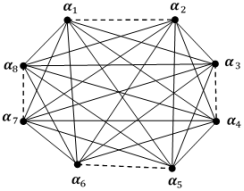
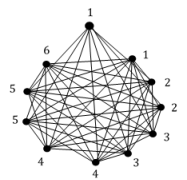
The graph is obtained by deleting the perfect matching, M, from the complete graph . Let and let . After deleting M, we observe the following:
, for each , .
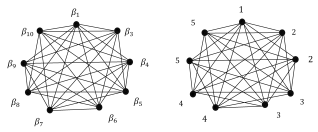
For, the graph
is illustrated in
Figure 1.
Theorem 2.1 provides the radial radio sequence of the graph .
Theorem 2.1
The radial radio sequence of is , for .
Proof
We have and . We observe that, the induced subgraphs induced by and , are isomorphic. This forces that, , . So that, it is enough to find radial radio number of , for some, , . Without loss of generality, assume that, .
We note that, is a clique in and so, by Theorem A,
Define such that .
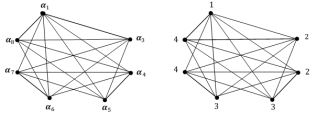
The induced subgraph
and its corresponding labeling under
are presented in
Figure 2.
Figure 2. a , b Labeling of
Since , by Lemma, we can say that is a radial radio labeling for the graph . Hence which implies that,
From the inequalities (
2) and (
3),
. Thus
, for all
,
.
3. Radial Radio Sequence of K2n+1-T, Where T Is a Minimum Edge Cover of K2n+1
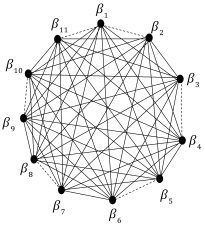
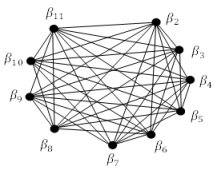
Assume that, . If we take , then T is the minimum edge cover of . We observe that,
is connected.
The graph
is illustrated in
Figure 3.
In this section, we determine the radial radio sequence of , for .
Theorem 3.1
For , the radial radio sequence of is .
Proof
Here, we identify three types of induced subgraphs arising from the deletion of an edge covering in the graph . These types are characterized as follows:
1) Induced subgraph induced by .
2) Induced subgraph induced by the vertices which are not adjacent to , that is, and .
3) Induced subgraphs induced by the vertices which are adjacent to .
We determine the radial radio numbers of each of these three types of induced subgraphs separately.
Case 1:
Subcase 1a:
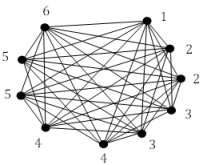
Figure 4. a in , 4b Labeling of in
For
, the sets
and
induce subgraphs both are isomorphic to
. Define
by
;
;
;
;
.
Figure 4 illustrates this labeling:
From
Figure 4, we note that, adjacent vertices receive distinct positive integers as labels and
is a clique, which proves that,
.
Subcase 1b:
For , the vertices in the sets and induce subgraph isomorphic to . Also, is the clique in , which implies that,
Define
by
;
,
;
,
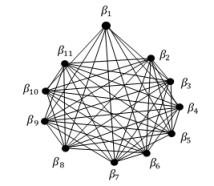
. The induced subgraph
of
is illustrated in
Figure 5.
Figure 5. a in , b Labeling of in
By Lemma, we confirm that is a radial radio labeling for, as the non-adjacent vertices get the distinct positive integers as labels. Thus and so
By inequalities (
4) and (
5), we have
.
Case 2: The vertices which are not adjacent to , that is, and .
We observe the following:
1) this implies that, .
2) .
3) .
Assume the induced subgraph induced by . Consider the sets of vertices:
Both the vertex sets (i) and (ii) induce subgraphs isomorphic to , which is a clique in and hence by Theorem A,
Define
such that
;
,
;
,
. The illustration of the function
is shown in
Figure 6.
(a)
Figure 6. a: in ; b: Labeling of in
Since , ; , and all adjacent vertices receive distinct positive integers as labels, by Lemma, we conclude that, is a radial radio labeling of . Hence and so
From inequalities, (
6) and (
7), we conclude that,
. Also,
.
Case 3: The vertices which are adjacent to . That is, the vertices belong to .
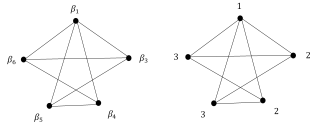
Note that: and , for every . Here, . Without loss of generality, assume that, . It is observed that, the set of vertices in (i) and (ii) induce subgraphs which are isomorphic to , which is a clique in :
By Theorem A,
Now, Define
such that,
,
;
.
Figure 7 shows the optimal radial radio labeling of the induced subgraph.
(a)
Figure 7. a: in ; b: Labeling of in
By Lemma, we can prove that, is a radial radio labeling of and and hence
Inequalities (8) and (9), proves that . Hence , .
Cases 1, 2 and 3 concludes that the radial radio sequence of is . This completes the proof.
4. Conclusion
In this paper, we determined the radial radio sequences of the connected induced subgraphs of the complete graph , which serves as our primary graph of interest. These results may be extended in future work to other specific families of graphs. It is important to note that the resulting graph must remain connected after the deletion of a perfect matching or an edge covering in order to define the radial radio sequence.
Abbreviations
| Complete Graph on Vertices |
| Radius of Graph |
| Radial Radio Number of Graph |
| Distance Between Vertices and |
| Closed Neighbourhood of Vertex |
| Radial Radio Number of the Induced Subgraph by Closed Neighbourhood of |
Acknowledgments
The author sincerely thanks the Management of Ayya Nadar Janaki Ammal College (Autonomous), Sivakasi, Tamil Nadu, India, for their constant support and encouragement. The authors also gratefully acknowledge the Postgraduate Department of Data Science, Computer Science Lab and the Science Instrumentation Centre of Ayya Nadar Janaki Ammal College for providing the necessary facilities and support to carry out this research work.
Author Contributions
Vimalajenifer Selvaraj: Conceptualization, Data curation, Formal Analysis, Investigation, Methodology, Project administration, Resources, Software, Supervision, Validation, Visualization, Writing – original draft, Writing – review & editing
Conflicts of Interest
The author declares that she has no conflicts of interest.
References
| [1] |
Selvam Avadayappan, M. Bhuvaneshwari, S. Vimalajenifer, The Radial Radio Number and the Clique Number of a Graph, International Journal of Engineering and Advanced Technology (IJEAT), Volume 9, Issue 1S4, pp. 1002-1006, December 2019.
|
| [2] |
Selvam Avadayappan, M. Bhuvaneshwari, S. Vimalajenifer, A Note on Radial Radio Number of a Graph, International Journal of Applied and Advanced Scientific Research, pp. 62–68, 2017.
|
| [3] |
Selvam Avadayappan, M. Bhuvaneshwari, S. Vimalajenifer, Radial Radio Sequence of a Graph, International Journal of Mathematical Combinatorics, Special Issue, pp. 1–8, 2018.
|
| [4] |
Selvam Avadayappan, M. Bhuvaneshwari and S. Vimalajenifer, rr-sequence product graphs, Advances in Mathematics: Scientific Journal, no. 3, pp. 927-936, 2020.
https://doi.org/10.37418/amsj.9.3.18
|
| [5] |
R. Balakrishnan and K. Ranganathan, A Textbook of Graph Theory, Second Edition, Springer, New York, 2012.
https://doi.org/10.1007/978-1-4614-4529-6
|
| [6] |
G. Chartrand, D. Erwin, F. Harary and P. Zhang, Radio labeling of graphs, Bulletin of the Institute of Combinatorics and its Applications, vol. 33, pp. 77-85, 2001.
|
| [7] |
W. K. Hale, Frequency Assignment: Theory and Applications, Proceedings of the IEEE, vol. 68, no. 12, pp. 1497-1514, 1980.
https://doi.org/10.1109/PROC.1980.11899
|
| [8] |
M. K. A. Kaabar, et al., Radio and Radial Radio Numbers of Certain Sunflower Extended Graphs, Journal of Mathematics, vol. 2022, Article ID 9229409, 2022.
https://doi.org/10.1155/2022/9229409
|
| [9] |
B. Mari, Further results on the radio number for some construction of the path, complete, and complete bipartite graphs, Heliyon, vol. 10, no. 15, e35678, 2024.
https://doi.org/10.1016/j.heliyon.2024.e35678
|
| [10] |
K. M. Paramasivam, K. Yenoke, B. S. K. Muralidharan, Radial radio number of chess board graph and king’s graph, TELKOMNIKA Telecommunication Computing Electronics and Control, vol. 20, no. 1, pp. 189–196, 2022.
https://doi.org/10.12928/TELKOMNIKA.v20i1.19493
|
| [11] |
R. Ponraj, S. Sathish Narayanan, Radio Mean Number of Certain Graphs, International Journal of Mathematical Combinatorics, vol. 4, pp. 45–53, 2021.
|
| [12] |
A. Rosa, On certain valuations of the vertices of a graph, Theory of Graphs (Internat. Symposium, Rome, July 1966), Gordon and Breach, N. Y. and Dunod Paris, pp. 349-355, 1967.
|
| [13] |
S. Vimalajenifer, Radial Radio Sequence of Path-Deleted, Cycle-Deleted and Star-deleted subgraphs of the complete Graph. (Submitted).
|
| [14] |
S. Vimalajenifer, Selvam Avadayappan, M. Bhuvaneshwari, Radial Radio Numbers of Subgraphs from Structured Deletions. (Communicated).
|
| [15] |
K. Yenoke, et al, Radial Radio Number of Hexagonal and Its Derived Networks, International Journal of Mathematics and Mathematical Sciences, vol. 2021, Article ID 5101021, 2021.
https://doi.org/10.1155/2021/5101021
|
Cite This Article
-
APA Style
Selvaraj, V. (2026). Radial Radio Sequences of Perfect Matching-deleted and Minimum Edge Covering-deleted Subgraphs of the Complete Graph Kn. American Journal of Applied Mathematics, 14(3), 168-173. https://doi.org/10.11648/j.ajam.20261403.17
 Copy
|
Copy
|
 Download
ACS Style
Selvaraj, V. Radial Radio Sequences of Perfect Matching-deleted and Minimum Edge Covering-deleted Subgraphs of the Complete Graph Kn. Am. J. Appl. Math. 2026, 14(3), 168-173. doi: 10.11648/j.ajam.20261403.17
Copy
|
Download
AMA Style
Selvaraj V. Radial Radio Sequences of Perfect Matching-deleted and Minimum Edge Covering-deleted Subgraphs of the Complete Graph Kn. Am J Appl Math. 2026;14(3):168-173. doi: 10.11648/j.ajam.20261403.17
Copy
|
Download
-
@article{10.11648/j.ajam.20261403.17,
  author = {Vimalajenifer Selvaraj},
  title = {Radial Radio Sequences of Perfect Matching-deleted and Minimum Edge Covering-deleted Subgraphs of the Complete Graph Kn},
  journal = {American Journal of Applied Mathematics},
  volume = {14},
  number = {3},
  pages = {168-173},
  doi = {10.11648/j.ajam.20261403.17},
  url = {https://doi.org/10.11648/j.ajam.20261403.17},
  eprint = {https://article.sciencepublishinggroup.com/pdf/10.11648.j.ajam.20261403.17},
  abstract = {Graph labeling is an important and rapidly developing area in graph theory due to its numerous applications in communication networks, frequency assignment, channel allocation, and coding theory. Among the various labeling methods, radial radio labeling has gained attention because of its connection with distance-based constraints and graph structure. In this paper, we study the radial radio labeling of certain connected subgraphs derived from complete graphs. We introduce the concepts of radial radio number and radial radio sequence and examine their behavior for specific graph classes obtained from complete graphs through edge deletions. The main objective of this work is to determine the radial radio sequence of connected graphs formed by deleting a perfect matching and an edge covering from the complete graph. Using fundamental graph-theoretic techniques and structural analysis, we derive exact values for the radial radio sequence of these graph families. The obtained results provide insight into the influence of graph structure and neighborhood properties on radial radio labeling. This study extends existing research on distance-based graph labeling and contributes to a better understanding of how structural modifications in graphs affect labeling parameters, which may further support applications in communication network optimization and interference reduction problems.},
 year = {2026}
}
Copy
|
Download
-
TY  - JOUR
T1  - Radial Radio Sequences of Perfect Matching-deleted and Minimum Edge Covering-deleted Subgraphs of the Complete Graph Kn
AU  - Vimalajenifer Selvaraj
Y1  - 2026/06/27
PY  - 2026
N1  - https://doi.org/10.11648/j.ajam.20261403.17
DO  - 10.11648/j.ajam.20261403.17
T2  - American Journal of Applied Mathematics
JF  - American Journal of Applied Mathematics
JO  - American Journal of Applied Mathematics
SP  - 168
EP  - 173
PB  - Science Publishing Group
SN  - 2330-006X
UR  - https://doi.org/10.11648/j.ajam.20261403.17
AB  - Graph labeling is an important and rapidly developing area in graph theory due to its numerous applications in communication networks, frequency assignment, channel allocation, and coding theory. Among the various labeling methods, radial radio labeling has gained attention because of its connection with distance-based constraints and graph structure. In this paper, we study the radial radio labeling of certain connected subgraphs derived from complete graphs. We introduce the concepts of radial radio number and radial radio sequence and examine their behavior for specific graph classes obtained from complete graphs through edge deletions. The main objective of this work is to determine the radial radio sequence of connected graphs formed by deleting a perfect matching and an edge covering from the complete graph. Using fundamental graph-theoretic techniques and structural analysis, we derive exact values for the radial radio sequence of these graph families. The obtained results provide insight into the influence of graph structure and neighborhood properties on radial radio labeling. This study extends existing research on distance-based graph labeling and contributes to a better understanding of how structural modifications in graphs affect labeling parameters, which may further support applications in communication network optimization and interference reduction problems.
VL  - 14
IS  - 3
ER  -
Copy
|
Download





 Share This Article
 Twitter
 Linked In
 Facebook